6.2L V8 · E85 (factory baseline on 91 octane)
2018 Chevrolet Silverado 1500 6.2L
Thirty-eight horsepower at the peak. The better number is underneath it: 43 more at 5,000 rpm and more torque everywhere a truck actually works.
Across the whole pull
+43 whp at 5,000 rpm, in the part of the rev range a truck lives in
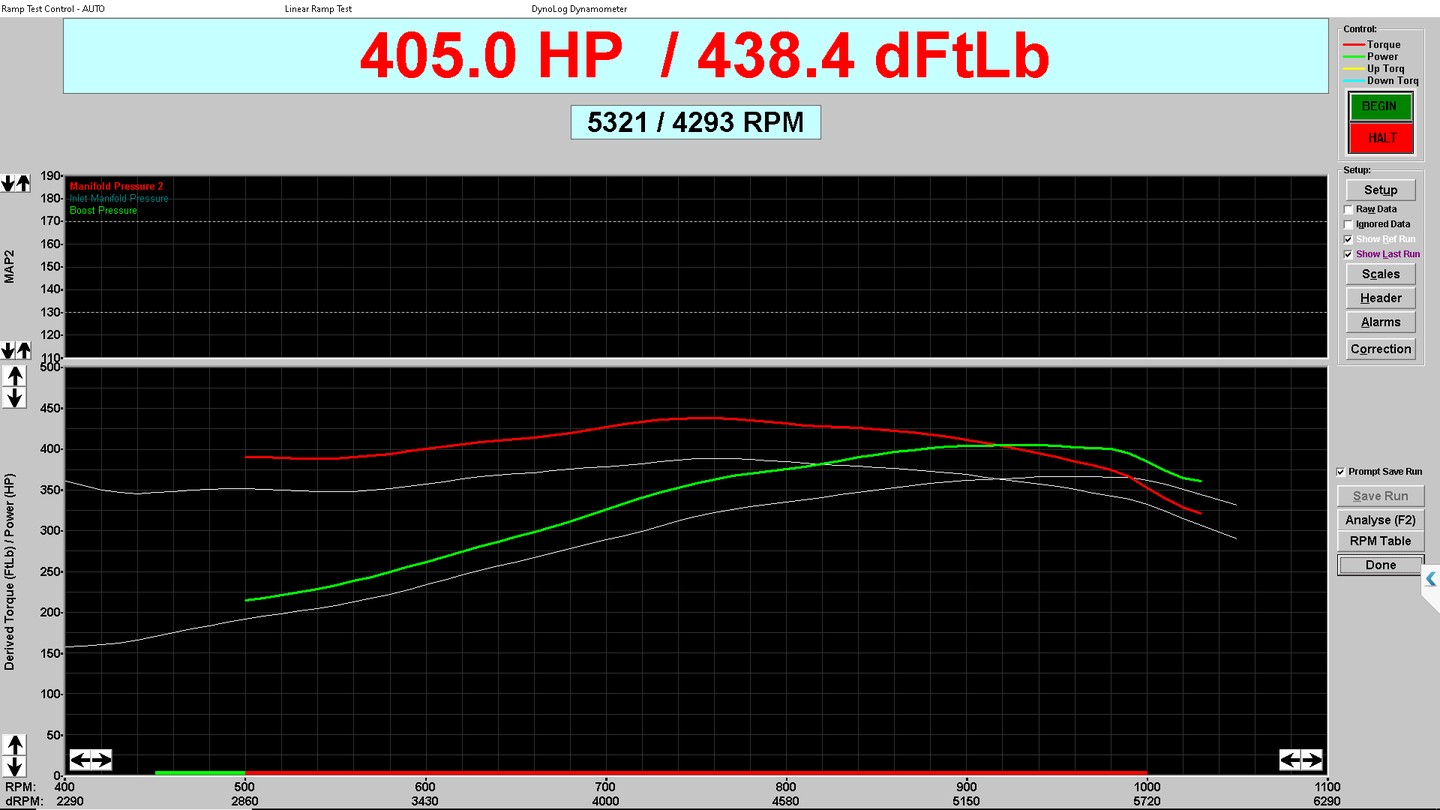
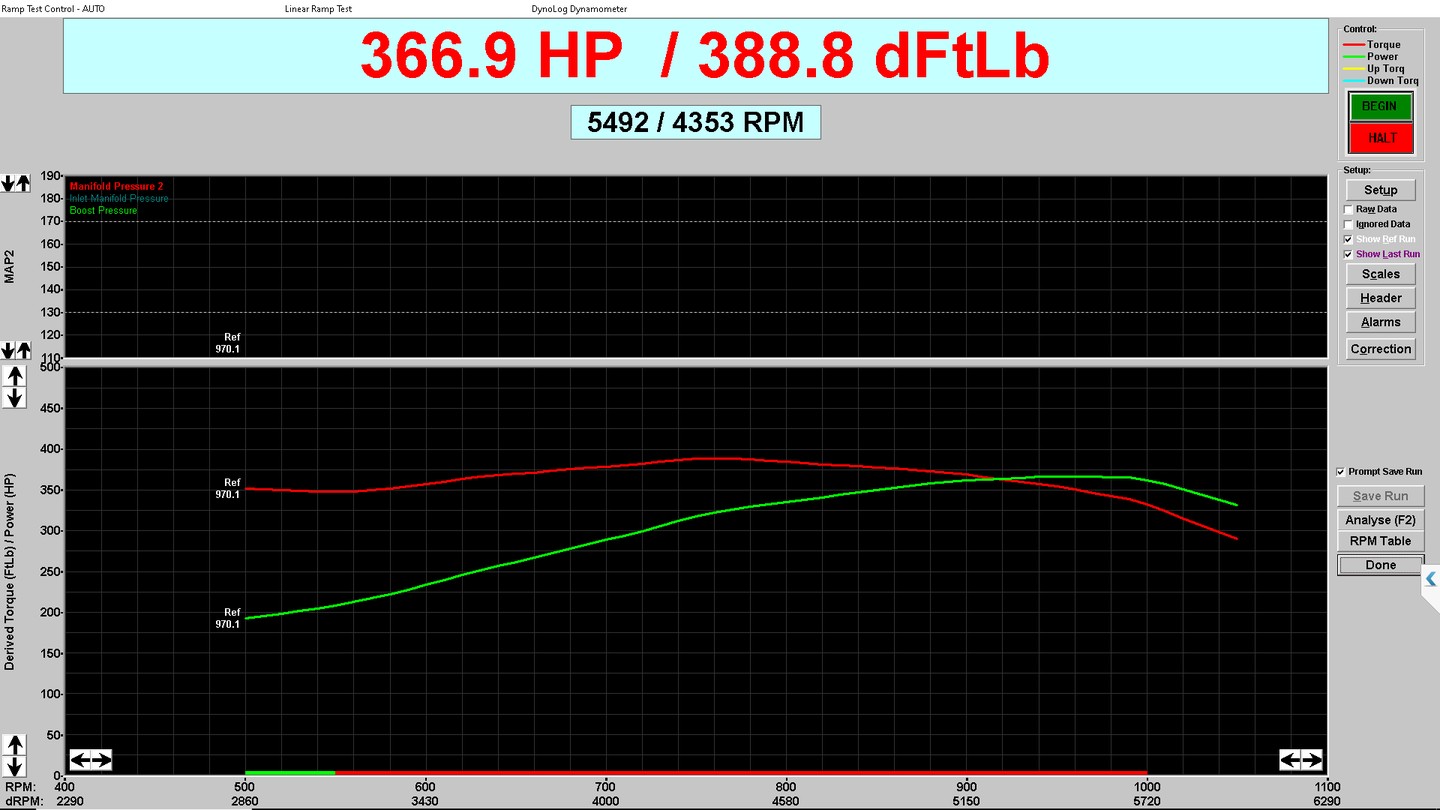
Peak to peak, 366.9 hp became 405.0. The bigger change is underneath it: more power from the bottom of the pull, and the most of it through the midrange.
- Factory calibration91 octane
- 366.9
- 388.8 lb-ft
- DEFI calibrationE85
- 405.0
- 438.4 lb-ft
- Factory calibration · 91 octane · 366.9 peak
- DEFI calibration · E85 · 405.0 peak
| rpm | Factory calibration, 91 octane | DEFI calibration, E85 | E85 vs the factory calibration |
|---|---|---|---|
| 3,000 | 200 hp · 350 lb-ft | 223 hp · 389 lb-ft | +23 hp |
| 3,500 | 240 hp · 360 lb-ft | 269 hp · 403 lb-ft | +29 hp |
| 4,000 | 288 hp · 378 lb-ft | 325 hp · 427 lb-ft | +37 hp |
| 4,500 | 331 hp · 386 lb-ft | 372 hp · 434 lb-ft | +41 hp |
| 5,000 | 356 hp · 374 lb-ft | 399 hp · 420 lb-ft | +43 hp |
| 5,500 | 366 hp · 350 lb-ft | 402 hp · 384 lb-ft | +36 hp |
What the dyno read
- Baseline
- 366.9
- 388.8 lb-ft
- After calibration
- 405.0
- 438.4 lb-ft
- Gain
- +38.1
- +49.6 lb-ft · +10.4%
Measured at the hubs on a Mainline ProHub in Corona, California, on E85 (factory baseline on 91 octane). Baseline taken on the factory calibration, on 91 octane.
Reading the result
A 2018 Silverado 1500 with the 6.2-litre V8, measured at the hubs on the factory calibration and 91 octane, then on our E85 calibration. 366.9 hp became 405.0, and 388.8 lb-ft became 438.4.
The peak is the smallest part of this. A truck spends its working life in the middle of the rev range — towing, merging, climbing a grade loaded — and that is where the calibration moved most: 37 hp more at 4,000 rpm, 43 hp more at 5,000, and between 42 and 49 lb-ft more torque everywhere from 3,500 to 5,000 rpm.
Why ethanol does this on an engine with no boost to turn up: the factory calibration on pump gasoline carries knock margin for the worst fuel and the hottest day the truck will ever see, and a high-compression direct-injection V8 lives right against that margin in the midrange, where cylinder pressure is highest. E85 resists detonation and cools the charge as it evaporates, so the calibration can carry more spark timing exactly there.
Above 5,500 rpm the two curves close up: 36 hp apart at 5,500 and 15 hp apart at 5,850, where the tuned pull ends. Up there this engine is limited by how much air it can move, and a calibration alone has much less to work with.
What this cost
E85 costs fuel economy, and on a truck that is a running cost you will notice. It is not at every pump, which matters more for a truck that tows away from home. The ethanol content of E85 moves with the season, which is why a flex-fuel sensor is worth having. And in California a modified calibration takes the truck out of emissions compliance.
The sheets on this page are the dyno software exactly as captured. They do not show the correction standard or the ambient conditions for each pull, and we are not going to fill those in from memory — they are being taken from the run files and will be published here. Until then, read these runs against each other rather than against a number from somebody else's dyno, and read how we measure for why that distinction matters.
The sheets
Every run on this page, as the dyno showed it
Uncropped captures of the Mainline DynoLog window. Colour is the run being shown; white is the reference run loaded under it. Open any sheet at full size and check the figures above against it.
Questions this result answers
How much power does an E85 tune add to a Silverado 6.2?
On this 2018 truck, measured at the wheels: 38.1 hp and 49.6 lb-ft at peak, and more than that through the midrange — 43 hp at 5,000 rpm. The gain is smallest near the top of the rev range, where the engine is limited by airflow.
More results
- 2023 Chevrolet Corvette C8 Stingray, Magnuson supercharged6.2L LT2 V8, Magnuson supercharger+41.9 hp
- 2021 Chevrolet Corvette C8 Stingray6.2L LT2 V8+47.5 hp
- 2023 Chevrolet Corvette C8 Z065.5L LT6 flat-plane V8+62.5 hp
- 2024 Chevrolet Corvette C8 Z065.5L LT6 flat-plane V8+59 hp
- 2006 Infiniti G35 drift carVQ35 V6, Vortech supercharger at 8 psi+53 hp
- 2013 Cadillac CTS-V6.2L LSA supercharged V8+29 hp
- 2016 Cadillac CTS-V6.2L LT4 supercharged V8521 hp
- 2019 Ford Mustang EcoBoost2.3L EcoBoost turbo four224 hp