6.2L LT2 V8, Magnuson supercharger · E30 (Magnuson baseline on 91 octane)
2023 Chevrolet Corvette C8 Stingray, Magnuson supercharged
The kit calibration peaks at 5,707 rpm and gives back 94 hp by 6,500. Ours holds on — 120 more wheel horsepower at 6,500 rpm.
Across the whole pull
+120 whp at 6,500 rpm, not just a bigger peak
Peak to peak, 537.1 hp became 579.0. The curve is where the result is: the kit calibration is falling after 5,707 rpm, and ours is still climbing to 6,345.
- Magnuson calibration91 octane
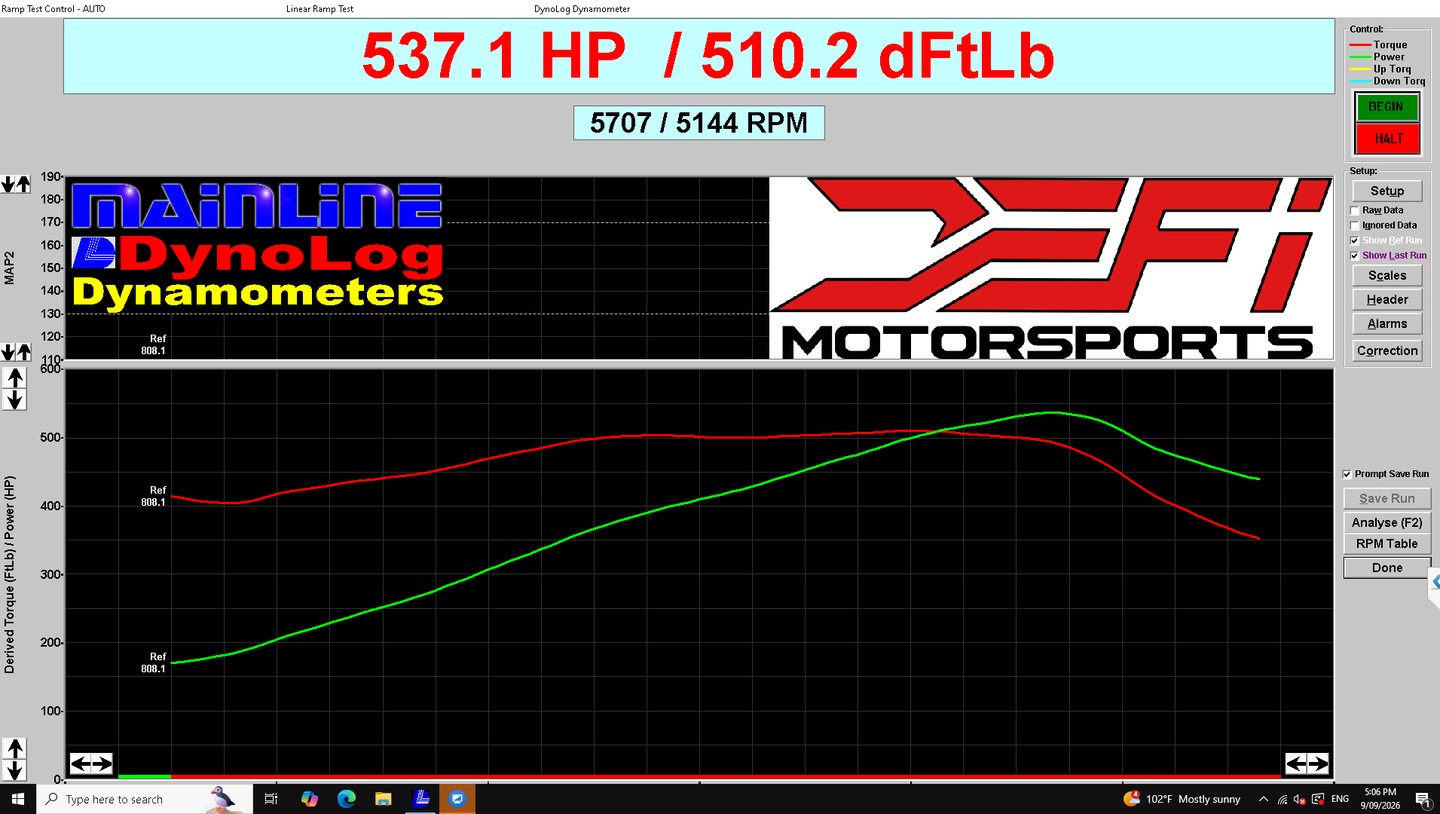
- 537.1
- 510.2 lb-ft
- DEFI calibration91 octane
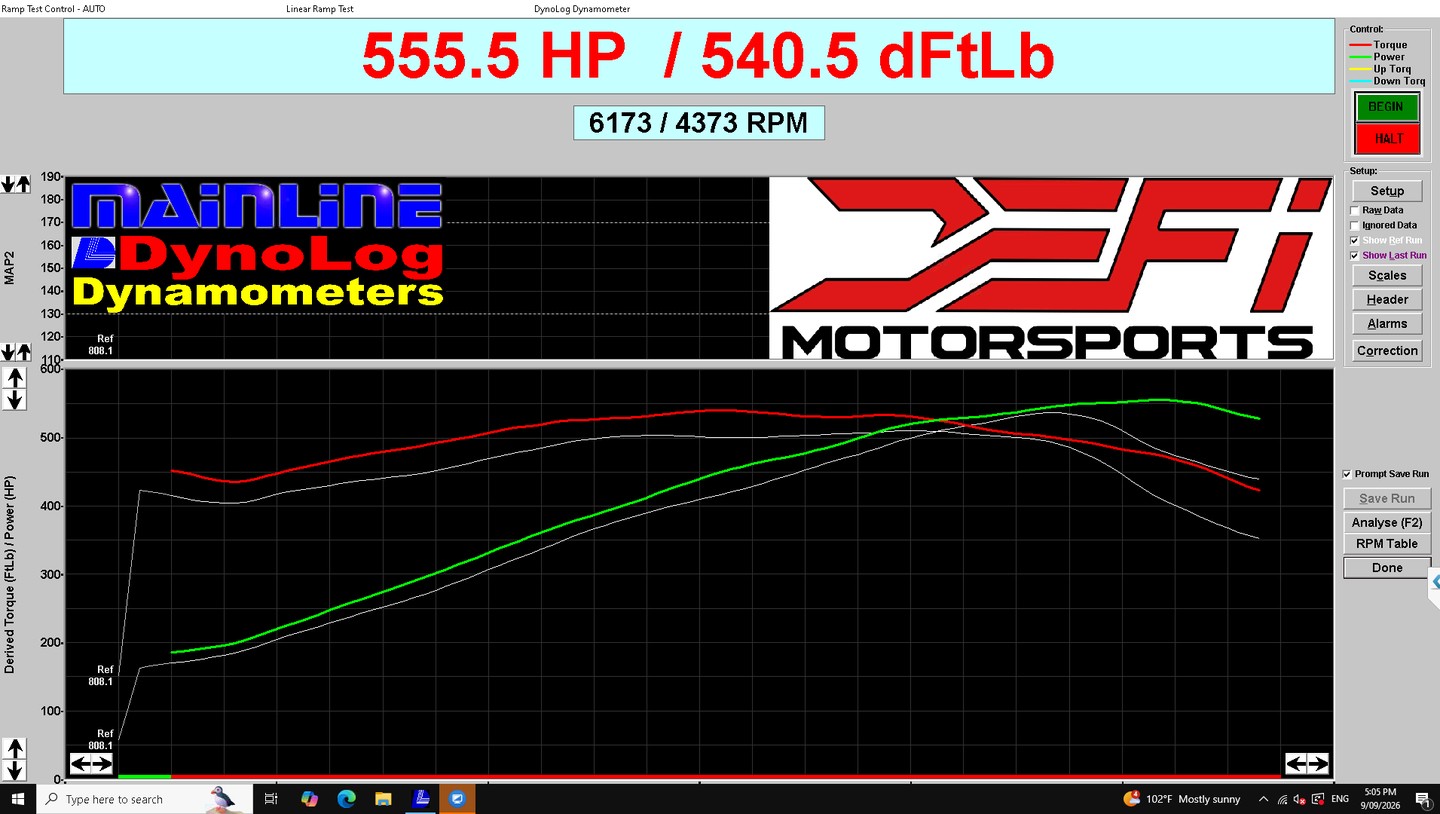
- 555.5
- 540.5 lb-ft
- DEFI calibrationE30
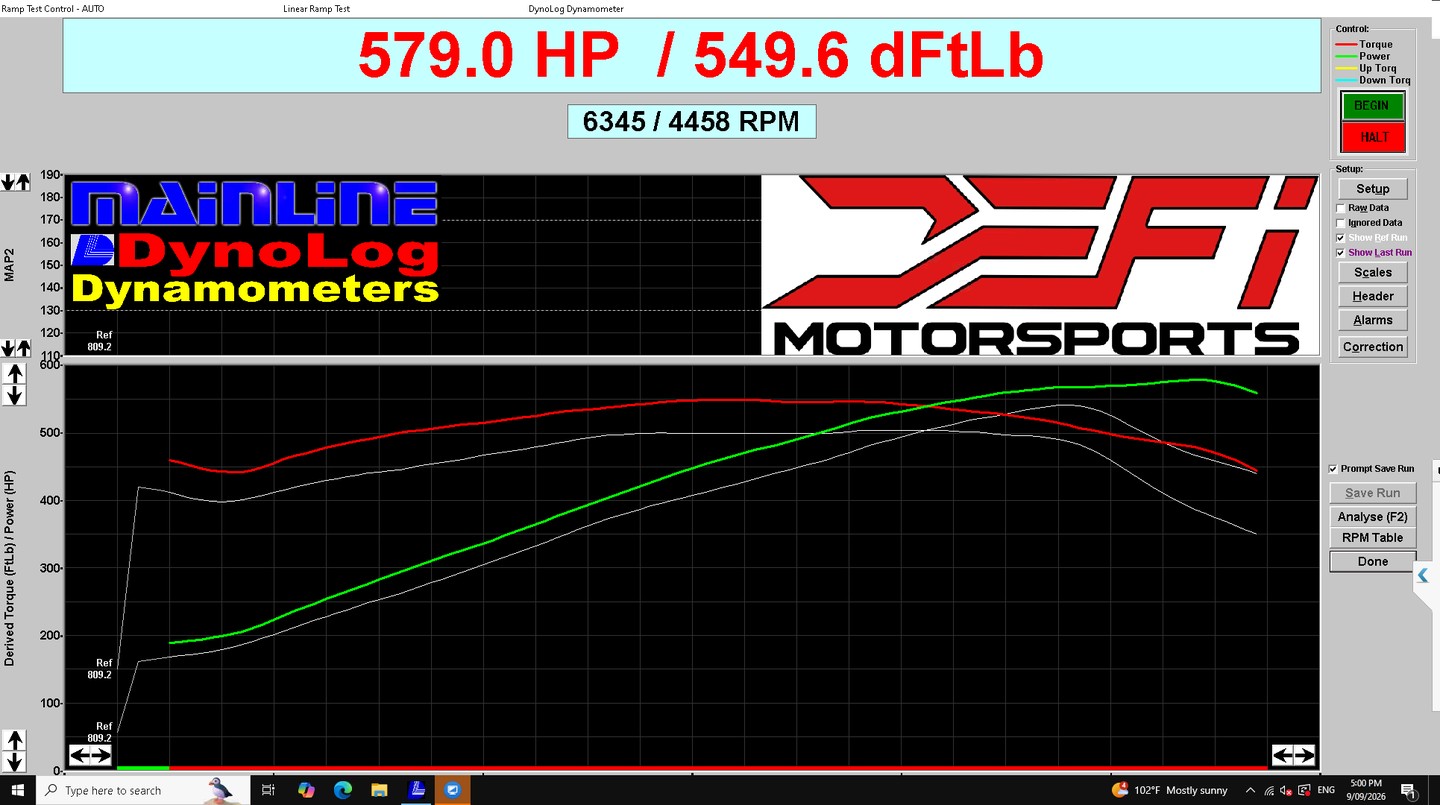
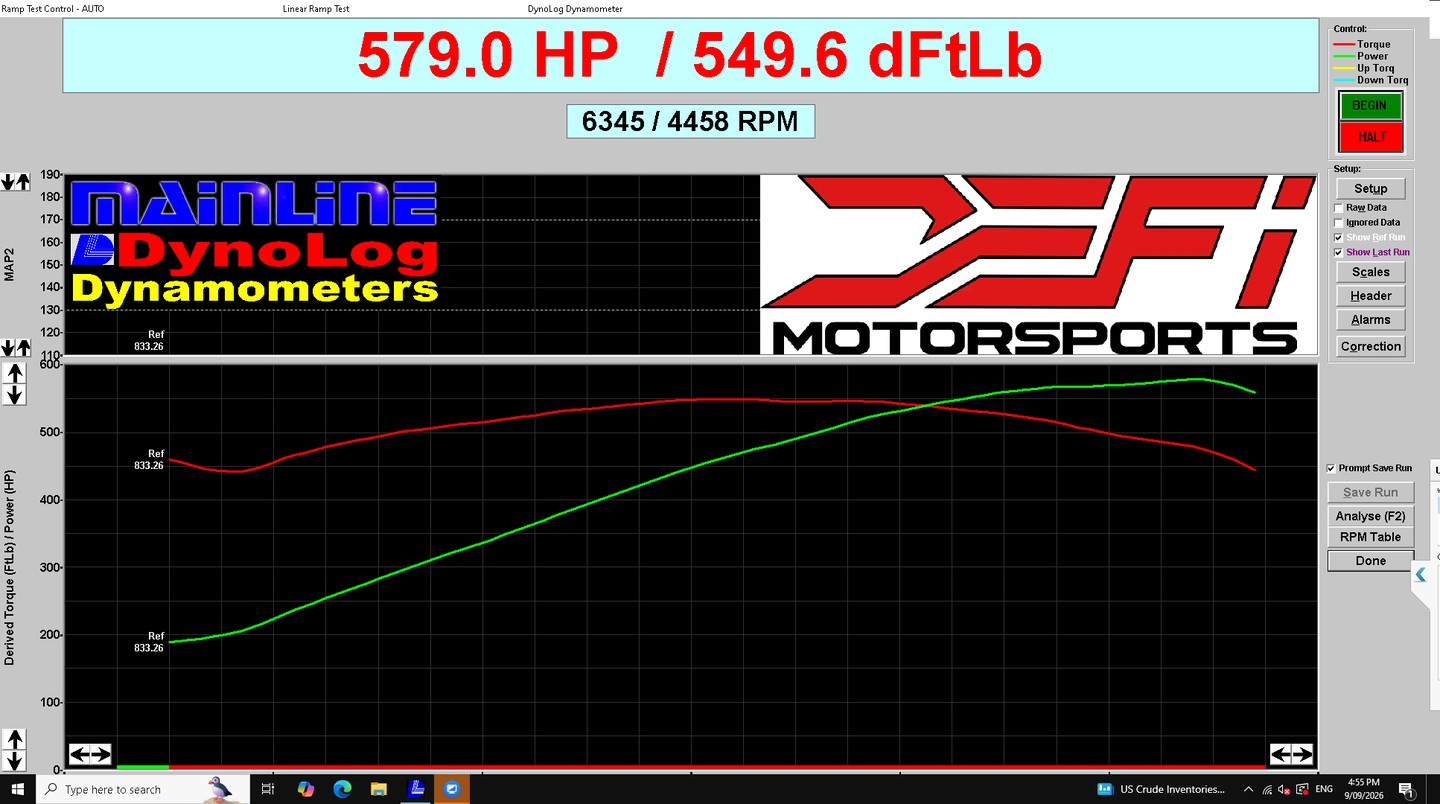
- 579.0
- 549.6 lb-ft
- Magnuson calibration · 91 octane · 537.1 peak
- DEFI calibration · 91 octane · 555.5 peak
- DEFI calibration · E30 · 579.0 peak
| rpm | Magnuson calibration, 91 octane | DEFI calibration, 91 octane | DEFI calibration, E30 | E30 vs the kit calibration |
|---|---|---|---|---|
| 3,000 | 250 hp · 439 lb-ft | 272 hp · 478 lb-ft | 280 hp · 492 lb-ft | +30 hp |
| 4,000 | 381 hp · 502 lb-ft | 402 hp · 529 lb-ft | 410 hp · 539 lb-ft | +29 hp |
| 4,500 | 427 hp · 500 lb-ft | 460 hp · 538 lb-ft | 469 hp · 549 lb-ft | +42 hp |
| 5,000 | 482 hp · 508 lb-ft | 506 hp · 533 lb-ft | 520 hp · 546 lb-ft | +38 hp |
| 5,500 | 526 hp · 502 lb-ft | 534 hp · 509 lb-ft | 555 hp · 530 lb-ft | +30 hp |
| 6,000 | 510 hp · 446 lb-ft | 552 hp · 482 lb-ft | 570 hp · 498 lb-ft | +44 hp |
| 6,250 | 470 hp · 395 lb-ft | 552 hp · 464 lb-ft | 576 hp · 484 lb-ft | +96 hp |
| 6,500 | 443 hp · 358 lb-ft | 532 hp · 429 lb-ft | 571 hp · 461 lb-ft | +120 hp |
What the dyno read
- Baseline
- 537.1
- 510.2 lb-ft
- After calibration
- 579.0
- 549.6 lb-ft
- Gain
- +41.9
- +39.4 lb-ft · +7.8%
Measured at the hubs on a Mainline ProHub in Corona, California, on E30 (Magnuson baseline on 91 octane). Baseline taken on the calibration supplied with the Magnuson kit, on 91 octane.
Reading the result
This is a 2023 C8 Corvette Stingray with a Magnuson supercharger, measured at the hubs three ways: on the calibration supplied with the kit, on our calibration with the same 91 octane in the tank, and on our calibration with E30. The peak figures are the least interesting part of the result — 537.1 hp to 579.0 hp. What matters is what happens after the peak.
On the Magnuson calibration, power peaks at 5,707 rpm and then falls away: 510 hp at 6,000 rpm and 443 hp at 6,500. Torque has been falling since its own peak at 5,144 rpm. We cannot see from the outside what that file is protecting against, and we are not going to guess. What we do know is the job a kit calibration has — it has to be safe on every car the kit ships to, on fuel of unknown quality, in heat nobody measured. That margin has to come from somewhere, and the top of the rev range is where this sheet shows it being taken.
Our calibration on the same 91 octane makes 552 hp at 6,000 rpm and 532 hp at 6,500 — 89 hp more than the kit calibration at 6,500 rpm, with nothing changed but the calibration. The peak only moves 18 hp. That is the case for writing a calibration on the car in front of you: the gain is not at the peak, it is in the last thousand rpm.
E30 is worth a further 39 hp at 6,500 rpm on top of that. Ethanol resists detonation and cools the intake charge as it evaporates, and on a supercharged engine that is precisely the margin that decides how much spark timing a calibration can carry under boost. The result is 579.0 hp at 6,345 rpm, 571 hp still there at 6,500, and 120 hp or more over the kit calibration at 6,500 rpm.
Why the last thousand rpm is the part to care about: a full-throttle upshift in an eight-speed dual-clutch drops the engine back into the middle of its range, not to idle. Under hard acceleration the car lives between its torque peak and the shift. A calibration that has fallen 94 hp off its own peak by 6,500 rpm is short of power in exactly the part of the range the car uses most.
On how the 120 is counted. Two pulls on the Magnuson calibration appear on the sheets below — one on its own sheet, one as the reference trace under the E30 overlay. They agree through the midrange and differ by several horsepower near the top. Against the first, the E30 calibration is 128 hp ahead at 6,500 rpm; against the second, 120. We quote the smaller number, for the same reason we publish the sheets at all.
What this cost
E30 is not a pump fuel. It is blended, usually from E85 and gasoline, and the ethanol content of E85 itself moves with the season, which is why a flex-fuel sensor is worth having on any car calibrated for it. Ethanol costs fuel economy. Whether a particular fuel system has the headroom for E30 under boost is checked under load, with lambda watched on every pass, before a calibration asks for it. More power at the top of the range is more load on the transmission and driveline every time it is used. And a custom calibration on a supercharged car is not covered by any emissions exemption the kit may carry as supplied — in California this car is for off-road and competition use.
The sheets on this page are the dyno software exactly as captured. They do not show the correction standard or the ambient conditions for each pull, and we are not going to fill those in from memory — they are being taken from the run files and will be published here. Until then, read these runs against each other rather than against a number from somebody else's dyno, and read how we measure for why that distinction matters.
The sheets
Every run on this page, as the dyno showed it
Uncropped captures of the Mainline DynoLog window. Colour is the run being shown; white is the reference run loaded under it. Open any sheet at full size and check the figures above against it.
Questions this result answers
Does a Magnuson-supercharged C8 Corvette need a custom tune?
It runs on the calibration supplied with the kit, and that calibration is written to be safe on every car it ships to. On this car that meant power peaking at 5,707 rpm and falling to 443 hp by 6,500. A calibration written on the dyno for this car, on the same 91 octane, made 532 hp at 6,500 rpm. Whether that is worth paying for depends on how the car is driven — the difference is at the top of the range, not at the peak.
How much power does E30 add to a supercharged C8?
On this car, against our own 91-octane calibration: 23.5 hp at peak and 39 hp at 6,500 rpm. Against the kit calibration on 91: 41.9 hp at peak and 120 hp or more at 6,500 rpm. The second comparison combines a fuel change and a calibration change, which is why this page shows the 91-octane run separately.
Why quote 120 hp when one of the sheets shows 128?
Two pulls on the Magnuson calibration are on the sheets, and they differ near the top of the range. The E30 calibration is 128 hp ahead of one and 120 hp ahead of the other at 6,500 rpm. Quoting the larger gap against the weaker baseline pull is how dyno numbers get inflated, so we quote the smaller.
Where is a Magnuson supercharger calibration done?
On a Mainline ProHub hub dyno at our shop in Corona, California. It is booked as a dyno session because it is developed under load, with knock, intake air temperature and lambda watched on every pass.
More results
- 2021 Chevrolet Corvette C8 Stingray6.2L LT2 V8+47.5 hp
- 2018 Chevrolet Silverado 1500 6.2L6.2L V8+38.1 hp
- 2023 Chevrolet Corvette C8 Z065.5L LT6 flat-plane V8+62.5 hp
- 2024 Chevrolet Corvette C8 Z065.5L LT6 flat-plane V8+59 hp
- 2006 Infiniti G35 drift carVQ35 V6, Vortech supercharger at 8 psi+53 hp
- 2013 Cadillac CTS-V6.2L LSA supercharged V8+29 hp
- 2016 Cadillac CTS-V6.2L LT4 supercharged V8521 hp
- 2019 Ford Mustang EcoBoost2.3L EcoBoost turbo four224 hp