6.2L LT2 V8 · E85 (factory baseline)
2021 Chevrolet Corvette C8 Stingray
Nineteen horsepower from calibration on pump gas, forty-seven on E85 — within a few horsepower of the last Stingray we put on this dyno.
Across the whole pull
+51 whp at 6,500 rpm, on E85, and ahead of stock from the bottom of the pull
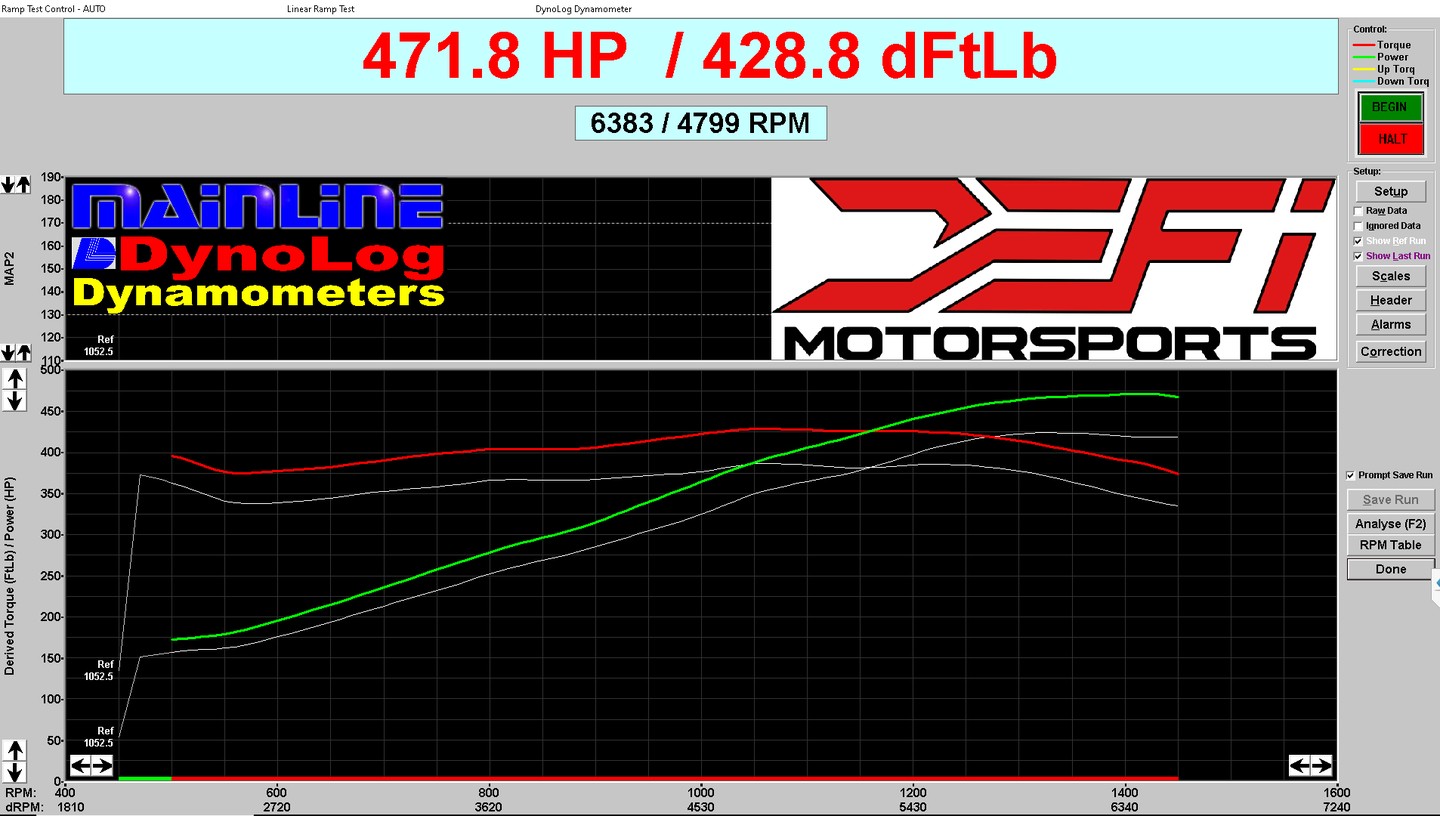
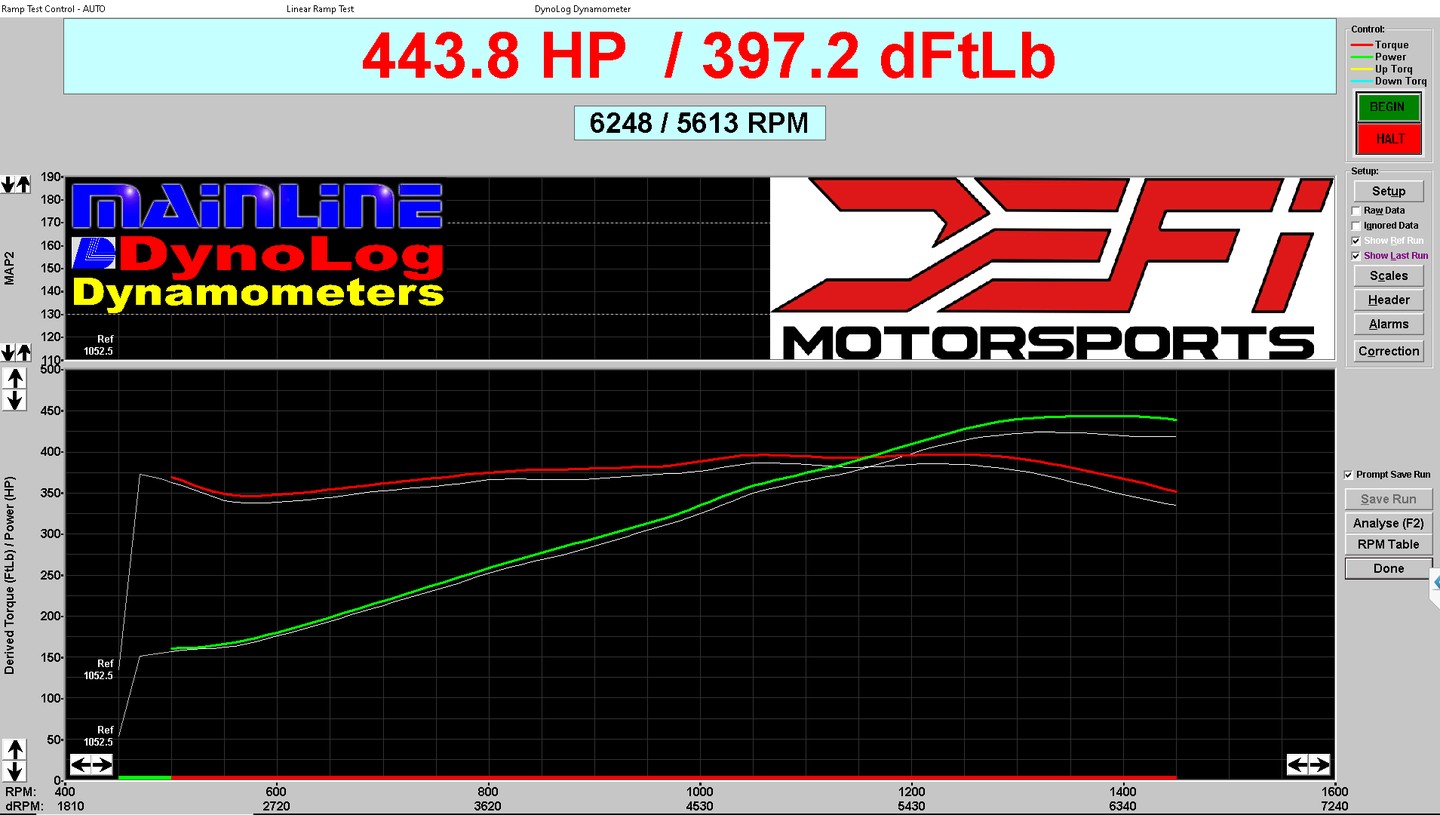
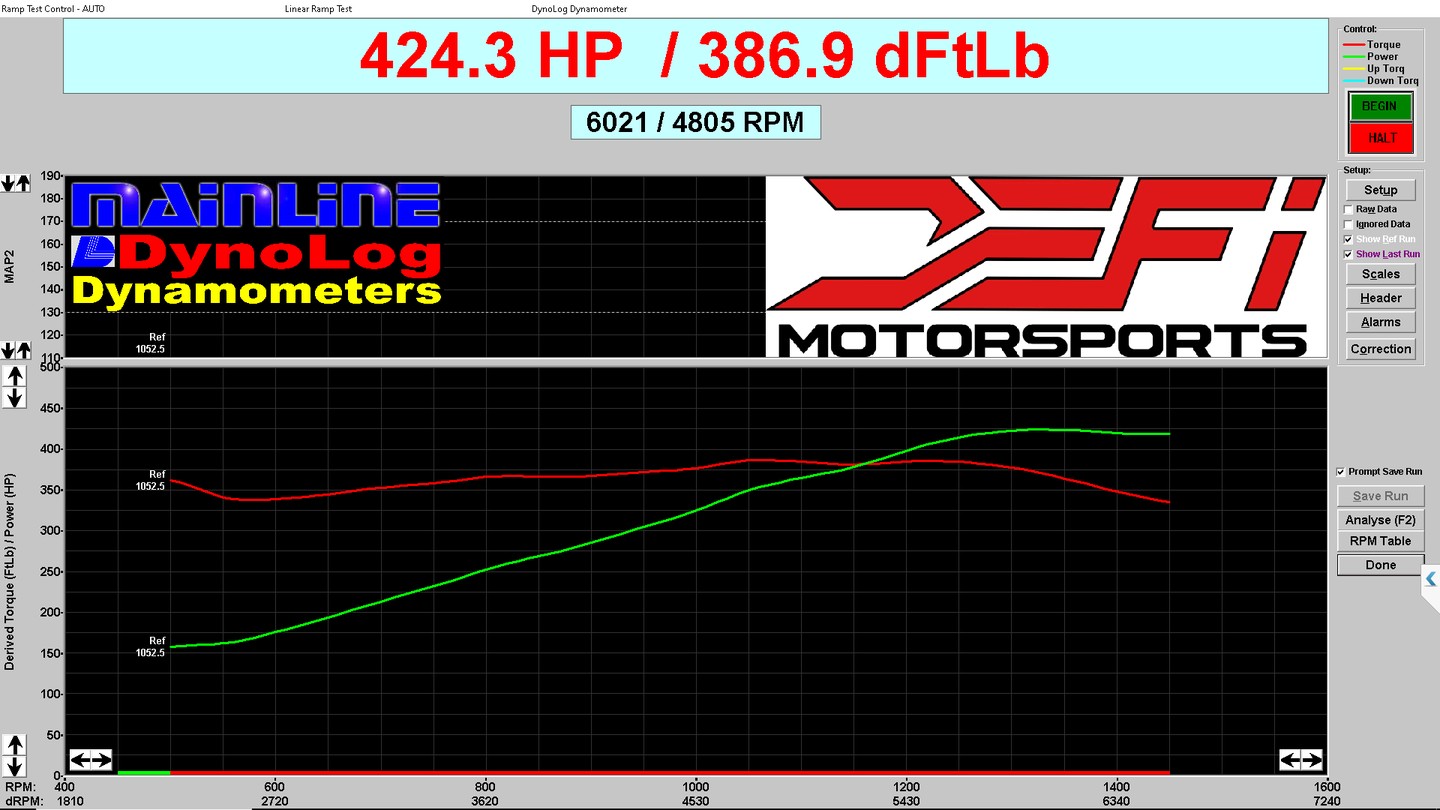
Peak to peak: 424.3 hp stock, 443.8 on 91 octane, 471.8 on E85. The E85 calibration is ahead of stock at every rpm on the sheet.
- Factory calibrationfuel not stated
- 424.3
- 386.9 lb-ft
- DEFI calibration91 octane
- 443.8
- 397.2 lb-ft
- DEFI calibrationE85
- 471.8
- 428.8 lb-ft
- Factory calibration · fuel not stated · 424.3 peak
- DEFI calibration · 91 octane · 443.8 peak
- DEFI calibration · E85 · 471.8 peak
| rpm | Factory calibration, fuel not stated | DEFI calibration, 91 octane | DEFI calibration, E85 | E85 vs stock |
|---|---|---|---|---|
| 3,000 | 198 hp · 347 lb-ft | 203 hp · 356 lb-ft | 219 hp · 385 lb-ft | +21 hp |
| 3,500 | 241 hp · 362 lb-ft | 248 hp · 372 lb-ft | 267 hp · 400 lb-ft | +26 hp |
| 4,000 | 279 hp · 366 lb-ft | 289 hp · 379 lb-ft | 308 hp · 404 lb-ft | +29 hp |
| 4,500 | 322 hp · 376 lb-ft | 332 hp · 387 lb-ft | 361 hp · 421 lb-ft | +39 hp |
| 5,000 | 366 hp · 384 lb-ft | 376 hp · 394 lb-ft | 407 hp · 427 lb-ft | +41 hp |
| 5,500 | 404 hp · 386 lb-ft | 415 hp · 397 lb-ft | 445 hp · 424 lb-ft | +41 hp |
| 6,000 | 424 hp · 371 lb-ft | 443 hp · 386 lb-ft | 467 hp · 408 lb-ft | +43 hp |
| 6,500 | 419 hp · 338 lb-ft | 441 hp · 355 lb-ft | 470 hp · 379 lb-ft | +51 hp |
What the dyno read
- Baseline
- 424.3
- 386.9 lb-ft
- After calibration
- 471.8
- 428.8 lb-ft
- Gain
- +47.5
- +41.9 lb-ft · +11.2%
Measured at the hubs on a Mainline ProHub in Corona, California, on E85 (factory baseline). Baseline taken on the factory calibration.
Reading the result
A 2021 C8 Stingray, measured at the hubs three times: on the factory calibration, on our 91-octane calibration, and on our E85 calibration. 424.3 hp, then 443.8, then 471.8.
On 91 octane the gain is small low down and grows with rpm: about 10 hp from 4,000 to 5,500 rpm, 18 hp at 6,000 and 22 hp at 6,500. That is what a naturally aspirated LT2 on pump gasoline has to give. The factory calibration is not leaving much on the table, and anyone promising fifty horsepower on 91 is quoting a different measurement, not a better tune.
E85 changes the whole curve, not just the top of it: 21 hp more at 3,000 rpm, 41 hp more at 5,000 and 5,500, and 51 hp more at 6,500 rpm. Peak torque rises 41.9 lb-ft.
The other Stingray published on this site is a different car from a different session, and it went 427.9, 449.6, 474.7. The two finish within three horsepower of each other on E85, and their gains land within about two horsepower on both fuels. That is what repeatable measurement looks like, and it is the straight answer to what a tune is worth on this platform: about twenty horsepower on pump gas, and about forty-seven on E85.
What this cost
E85 costs fuel economy and is not sold everywhere, and the ethanol content of E85 moves with the season, which is why a flex-fuel sensor is worth having on any car calibrated for it. The LT2 is direct-injected, and whether a particular fuel system holds E85 at full load is checked under load with lambda watched on every pass, not assumed. And a modified calibration takes the car out of emissions compliance in California.
The sheets on this page are the dyno software exactly as captured. They do not show the correction standard or the ambient conditions for each pull, and we are not going to fill those in from memory — they are being taken from the run files and will be published here. Until then, read these runs against each other rather than against a number from somebody else's dyno, and read how we measure for why that distinction matters.
The sheets
Every run on this page, as the dyno showed it
Uncropped captures of the Mainline DynoLog window. Colour is the run being shown; white is the reference run loaded under it. Open any sheet at full size and check the figures above against it.
Questions this result answers
How much horsepower does a tune add to a C8 Stingray?
On this 2021 car, measured at the wheels: 19.5 hp at peak on 91 octane and 47.5 hp on E85. Another Stingray on the same dyno gained 21.7 and 46.8. On pump gas the honest number for this platform is about twenty.
Is a 91-octane tune worth it on a C8 Stingray?
It depends what you want from the car. On 91 the gain is about 10 hp through most of the range and about 20 near redline. E85 more than doubles the peak gain, at the cost of fuel economy and fuel availability.
More results
- 2023 Chevrolet Corvette C8 Stingray, Magnuson supercharged6.2L LT2 V8, Magnuson supercharger+41.9 hp
- 2018 Chevrolet Silverado 1500 6.2L6.2L V8+38.1 hp
- 2023 Chevrolet Corvette C8 Z065.5L LT6 flat-plane V8+62.5 hp
- 2024 Chevrolet Corvette C8 Z065.5L LT6 flat-plane V8+59 hp
- 2006 Infiniti G35 drift carVQ35 V6, Vortech supercharger at 8 psi+53 hp
- 2013 Cadillac CTS-V6.2L LSA supercharged V8+29 hp
- 2016 Cadillac CTS-V6.2L LT4 supercharged V8521 hp
- 2019 Ford Mustang EcoBoost2.3L EcoBoost turbo four224 hp